
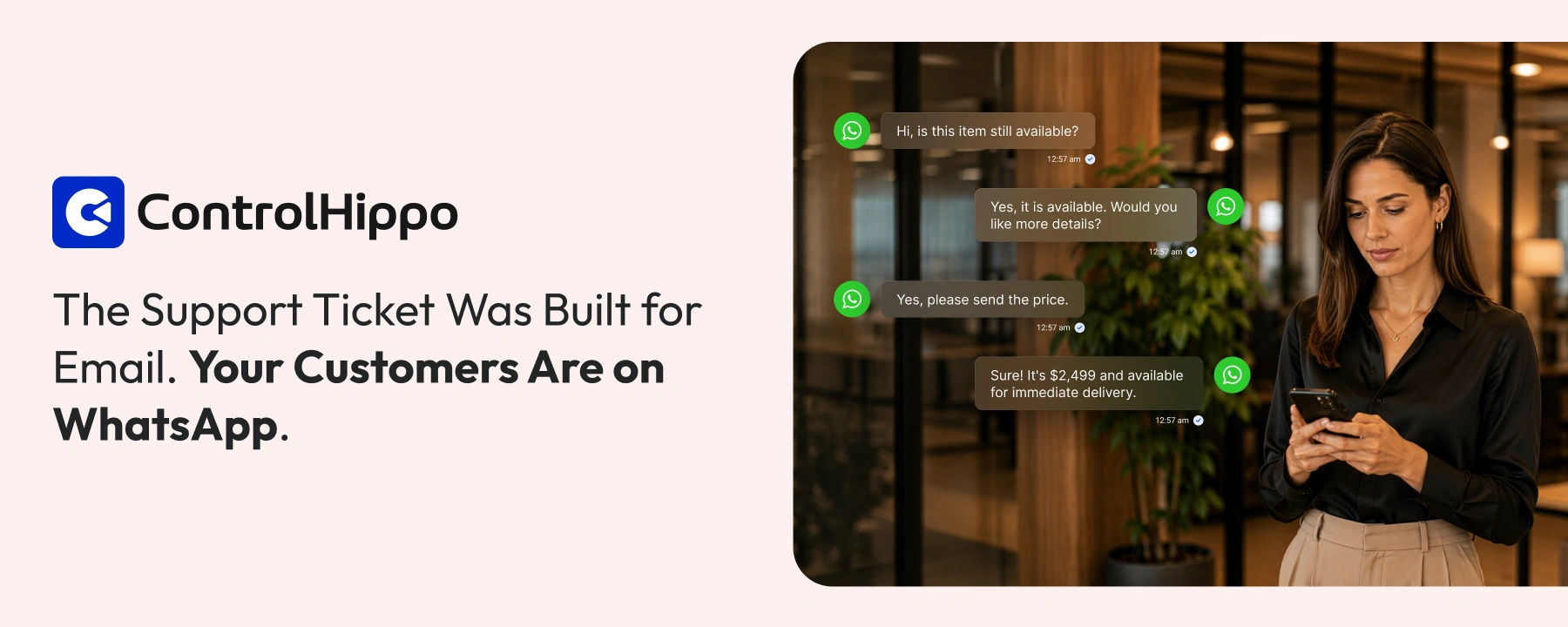

For most companies, support still runs on a model designed twenty years ago. A ticket gets opened, a queue forms, and a response comes hours or sometimes days later.
That model made sense when waiting was acceptable. It does not work anymore in 2026.
This blog is about the gap between how your support function is built and how your customers actually behave.
The gap is wider than it looks. And it is costing you, customers you never see leaving.
Slow Replies Are Costing You Customers That You Never See Leaving
Let me walk you through a scene that plays out every day in 2026.
A customer has an urgent issue with an order from yesterday. They open WhatsApp and message the company’s official business account. Within seconds, they receive an automated reply: “Your ticket number #4521 has been received. Expected response time is 24 to 48 hours.”
They wait one full hour for an update. Then they wait two more hours without a reply. By the third hour, they have already posted publicly about the issue.
But what’s worse is that they have also placed a new order with a competitor. The ticket itself is still marked “Open” inside the company’s support system.
Ticket Systems Were Built for a World Where Waiting Was Normal
The ticket system was never the villain in this story. It was a rational design for its era.
Twenty years ago, a 24 to 48-hour response window was genuinely acceptable. The alternative was a phone queue that ran longer than that.
The ticket created two things customers genuinely valued at the time:
- Accountability: a record that the business owed them a response
- Documentation: a paper trail of the request and resolution
Email was the fastest channel a customer had at their disposal. The system made perfect sense when waiting was the only option.
Today, customers no longer compare your response time to a phone queue. They compare it to their personal messaging inbox instead. That comparison is where every ticket system in the world quietly loses ground every day.d
“The ticket system is not broken. It is not optimized for the rising customer expectation.”
WhatsApp Trained Your Customers to Expect a Reply in Minutes
Three billion people now use WhatsApp, Telegram, and Instagram every day. They have learned to expect a reply in minutes, often closer to two than five.
That expectation does not disappear when the conversation shifts to a business. The customer who texts a friend in thirty seconds will not wait twenty-four hours for a business they pay.
Three things every executive should know in 2026:
- First response time now strongly predicts customer satisfaction. In many categories, it outranks resolution quality itself.
- The expectation gap is structural, not attitudinal. Customers are not being unreasonable or entitled.
- They are using the mental model that every messaging app trains them on. Your business does not get a free pass on this baseline.
The companies winning on customer experience are the ones who saw this shift first.
 Explore our Best 6 AI Customer Support Software
The Companies With the Highest Support Scores Stopped Using Tickets
The companies leading customer service today have already redesigned the support model. The shift looks operationally simple, but conceptually, it is large.
What the new support model looks like:
- A shared inbox replaces the ticket queue. Messages from WhatsApp, Telegram, Instagram, and email arrive in one unified view.
- Agents are assigned in real time. Not by ticket number, not by queue position.
- No queue delay. No “ticket created” auto-reply.
Platforms like ControlHippo consolidate every messaging channel into a single omnichannel inbox.
A small support team can cover WhatsApp, Telegram, and Instagram from one view. Messages get assigned and answered in the same window that a customer expects from any messaging app.
Add AI on top, and the model scales further.
A customer service AI agent is not built to replace humans in the loop. It handles routine questions instantly so your team can focus on what actually needs human judgment. This is what modern customer service automation looks like in 2026.
Explore our Best 15 Ways To Use AI in Customer Service + ExamplesEvery Month You Wait, a Competitor Is Having That Conversation Instead
The ticket system will not disappear overnight. It is embedded in too many workflows, too many SLA documents, and too many compliance reviews.
But holding onto it for high-volume messaging carries a hidden cost. That cost does not show up on any dashboard your CFO reviews.
Every month that passes, a competitor is having that real-time conversation with a customer who filed a ticket with you. Web chat tools make it easier for businesses to provide these real-time conversations directly on their websites.
The decision in front of every executive team in 2026:
The shift has already happened on the customer side. What remains is only the timing question.
- Move now: before churn shows up in next quarter’s numbers.
- Move later: after lost customers turn into a board-level question, nobody wants to answer.
“The question is not whether messaging will replace the ticket. The question is whether your company will make that move before or after your customers do.”
Conclusion
Companies still managing customer messaging through ticket queues are not behind on features. They are behind on their operating model entirely. Replacing the queue with a shared inbox is the lowest-friction operational shift available right now.
It does not require ripping out your CRM or restaffing your support team. It just requires recognizing that the rules of customer service have already changed underneath us.
Move Past the Ticket Queue Support System with ControlHippo
Schedule a Free Demo Now

Jainy Patel is a content strategist who specializes in omnichannel communication solutions. She develops innovative marketing strategies that unify messaging across various channels, ensuring a consistent and engaging customer journey. Jainy is passionate about optimizing communication processes and crafting targeted content that resonates with audiences at every touchpoint.